


Pneumatics / Manually Operated Directional Valves
Rotary Slide Valves – Manually Operated Pneumatic Valves
Rotary slide valves control compressed air purely mechanically: the operator turns the hand lever, and the rotary slide inside the valve body connects the compressed air port, working ports, and exhaust. No electricity, no pilot air, no electronics – the selected position stays engaged even when the operator releases the lever. That's exactly why rotary slide valves are the typical choice for manual controls on double-acting cylinders, for setup and tooling operations, and for fixtures that are deliberately designed to work without any control system.
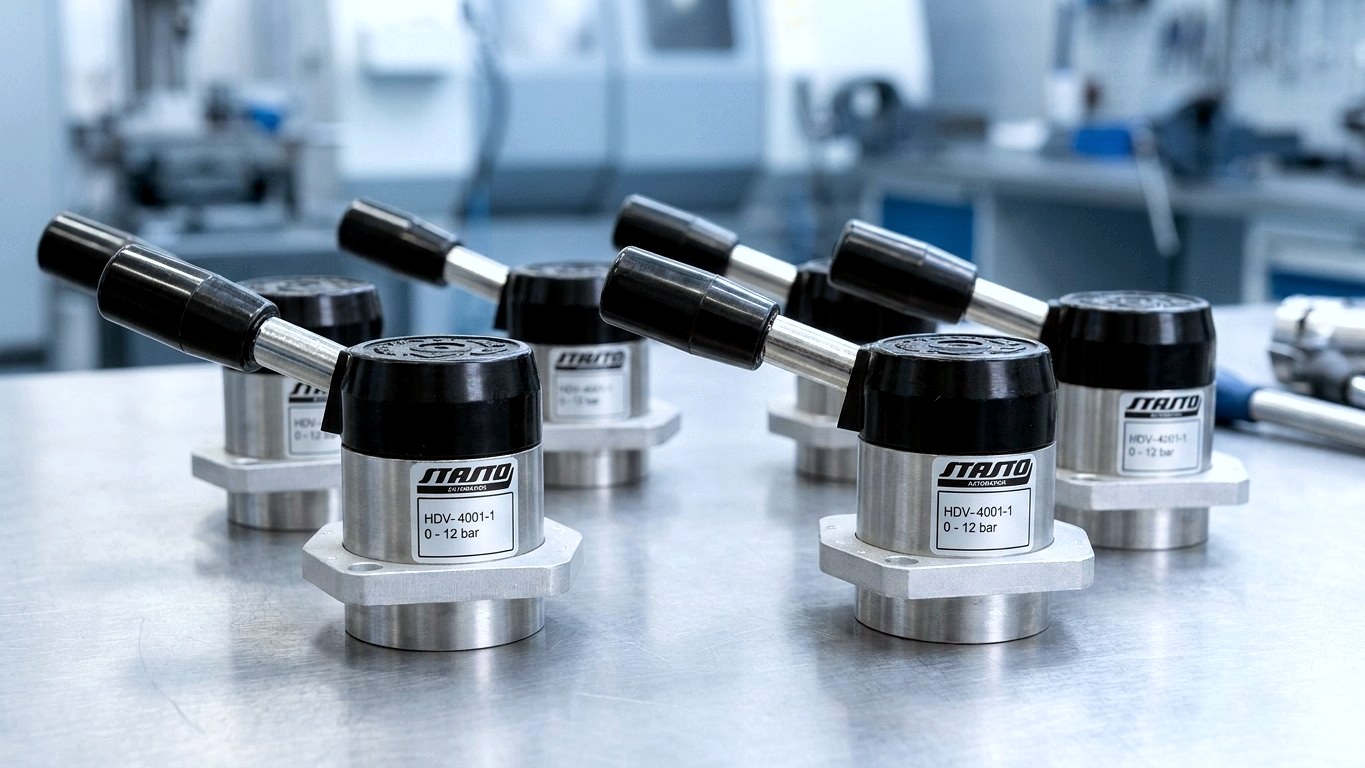
Series HDV at a Glance
Why rotary spool valves
Mechanical switching – clear, detented, no electrics
Rotary spool valves of the HDV series combine a simple operating principle with clear selection criteria: switching function, port size, DN, and connection position. This lets you quickly find the version that fits your cylinder and control setup.
Switching without power – detented and unambiguous
The hand lever locks into each switching position, so the valve position is always visible and tactile. For applications without electrical infrastructure, or as a deliberately simple manual control, this is the most direct path to functionality.
Three switching functions for different cylinder tasks
4/3-way with closed center position holds the cylinder in place, 4/3-way with exhausted center position depressurizes it for free movement, and 4/2-way switches directly between two end positions. Select the function based on the desired behavior at rest.
Sealless rotary spool principle
According to the manufacturer, the valves operate with a lapped plastic rotary spool (Delrin/POM) in an anodized aluminum housing and require no sealing elements in the spool area – provided sufficiently filtered compressed air is used.
Four sizes, two port orientations, accessories
From G1/8 (DN 5) to G1/2 (DN 9), each available with side ports (…-N) or bottom ports (…-I) for front-panel or panel mounting. For size G1/4, the rotary spool element and plastic cover are available as spare parts.
Guide
Selecting the Right Rotary Spool Valve
Design type and switching diagram are two separate selection criteria. The following sections explain the operating principle of the Series HDV and the key criteria for sizing.
Operating Principle and Switching Function
- What a Rotary Spool Valve Is
- A rotatable spool sits inside the valve body. As the hand lever is turned, it moves across the port openings, connecting or blocking them. The Series HDV is a 4-way valve: one compressed air inlet, two working ports, one exhaust.
- 4/3 with Closed Center Position
- In the center position, both working ports are closed off. The trapped air holds the position – due to compressibility this provides holding, not precise positioning.
- 4/3 with Exhausted Center Position
- Both working ports are connected to exhaust. The cylinder becomes pressureless and can be moved by hand – the choice for setup and service functions.
- 4/2 Version
- Two stable positions, direct switching between retracting and extending, with no neutral intermediate position.
- Detent and Return Behavior
- The HDV versions with three positions are detented: the selected position is maintained until actively changed. For spring return, we offer lever, push-button, and foot-operated valves.
Sizing: Port, DN, Flow Rate, Pressure
- G1/8 · DN 5 · 480 Nl/min
- For small cylinders and auxiliary functions.
- G1/4 · DN 7 · 1050 Nl/min
- Most widely used size for standard applications.
- G1/2 · DN 9
- For large cylinder volumes and short stroke times; we confirm the flow value based on the manufacturer's datasheet – until then available on request.
- Pressure range 0…12 bar
- All variants of the series are rated for 0…12 bar. The operating medium is compressed air; per manufacturer specification, adequate filtration is a prerequisite.
- Four specifications for sizing
- Piston diameter, stroke, desired stroke time, and hose length – these are what we use to determine the right size.
- Connection position …-N / …-I
- …-N stands for side connections, …-I for bottom-mounted connections for installation behind a front panel.
Switching Functions Compared
4/3 closed center, 4/3 exhaust center, or 4/2?
The HDV series is available in three switching functions. The decisive factor is the desired cylinder behavior at rest.
| 4/3 mid-position closed | 4/3 mid-position exhausted | 4/2 | |
|---|---|---|---|
| Mid-position behavior | Both working ports closed, cylinder is held in position | Both working ports exhausted, cylinder is pressure-free | No mid-position – two stable positions |
| Typical application | Stopping at intermediate positions, clamping, holding | Setup and service operation, manual repositioning | Direct switching between extend and retract |
| Actuation | Hand lever, detented | Hand lever, detented | Hand lever, two stable positions |
| Available Port Sizes | G1/8, G1/4, G1/2 | G1/8, G1/4, G1/2 | G1/4 |
| Port Position | side (…-N) and bottom (…-I) | side (…-N), G1/8 also bottom (…-I) | side (…-N) and bottom (…-I) |
| Note | Holding, not for precise positioning | No residual pressure in the cylinder | Further combinations on request |
Product Range
Rotary spool valves and related manual valves
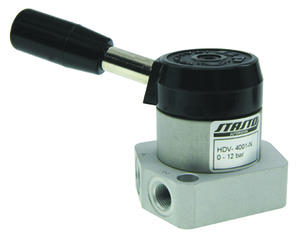
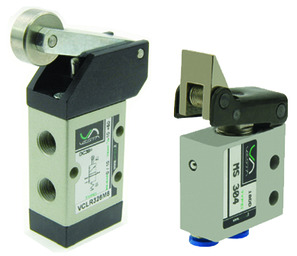
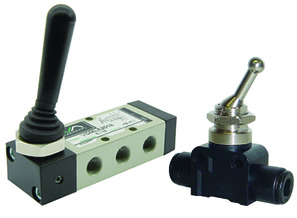
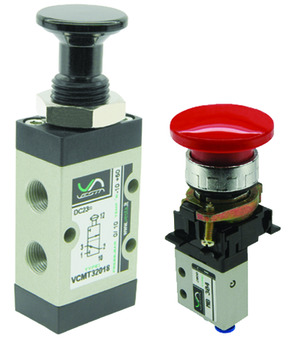
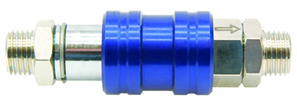
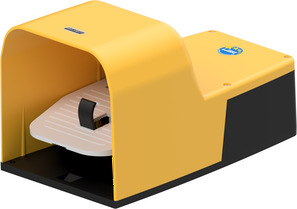
Not every manual control requires a rotary spool valve. Depending on the operating situation – foot actuation, push-button, end-position sensing at the workpiece, or logical combination of several signals – a different mechanically actuated design may be a better fit.
In Practice
Typical Applications
Rotary spool valves are used wherever a pneumatic movement needs to be switched directly by hand, without a separate control system.
Manual Control of Double-Acting Cylinders
A 4-way valve supplies both cylinder chambers and handles exhaust: for clamping fixtures, locking devices, and swivel units. If the cylinder is to stop in an intermediate position, select the blocked mid-position.
Setup, Commissioning, and Maintenance Operations
A rotary spool valve in the bypass branch moves an axis directly on the machine, without a programming device or control voltage. The exhausted mid-position depressurizes the cylinder for tool changes and troubleshooting.
Front Panel and Panel Mounting
Versions with bottom-mounted ports (…-I) are installed in control panels and fixture housings so that only the hand lever remains visible, with the piping routed protected behind the panel.
Flaps and Gate Valves on Containers
Flaps, gate valves, and material shutoffs on containers can be operated clearly and traceably with a manual valve – without electrical actuation on the motion axis.
Simple Fixtures and Auxiliary Functions
Blow-off nozzles, ejectors, hold-downs, material slides, or test setups can be fully operated with a manual valve – reducing effort for wiring, programming, and documentation.
Environments Without Electrical Control
Where electrical wiring is deliberately not routed to the motion axis, pneumatic manual control remains the solution. The rotary spool valve operates without power and without pilot air – the operator's actuating force is sufficient.
Availability
Availability and lead time
Availability varies by variant. We will provide the binding delivery date with the quote or upon request for the specific part number.
Depending on the variant
Common sizes in the HDV series are kept in stock; less frequently requested versions are procured to order.
Lead time with the quote
Please provide quantity, switching function and desired port position – price and lead time will be provided for the specific part number.
Special versions on request
For special versions – for example with internal parts made of chrome-plated brass as well as hand lever and screws made of stainless steel – price and lead time are available on request.
Spare parts and accessories
For size G1/4, the rotary spool element and plastic cover are available as spare parts; price on request.
How to find the right variant
Sizing in three steps
Body style, switching function, and size can be narrowed down systematically – we support you in the sizing process.
Define the switching function
Should the cylinder be held in an intermediate position (4/3 closed center), depressurized and manually movable (4/3 exhausted center), or simply switch between two end positions (4/2)?
Select size and port orientation
Provide us with piston diameter, stroke, desired travel time and hose length, as well as the mounting type – side ports (…-N) or bottom ports (…-I) for front-panel mounting.
Request part number
We confirm the variant, price, and delivery date with you. Additional combinations and special versions are available on request.
Frequently Asked Questions
Rotary spool valves – frequently asked questions
Short answers on design, switching function, mounting and sizing.
What is a rotary spool valve?
A rotary spool valve is a manually operated pneumatic valve in which a rotating spool inside the valve body moves across the port openings, connecting or isolating them. It is actuated by a hand lever – without electricity, pilot air or electronics. The HDV series is designed as a 4-way valve with one compressed air inlet, two working ports and one exhaust port.
What is the difference between a closed and an exhausted center position?
With a closed center position, both working ports are blocked and the cylinder is held in place; with an exhausted center position, both working ports are vented and the cylinder becomes pressure-free. The closed version is suitable for stopping in intermediate positions, while the exhausted version is used for set-up and service functions where the cylinder needs to be moved by hand.
Are rotary spool valves detented or spring-returned?
The three-position HDV versions are detented – the selected position is maintained until it is actively changed. If a valve should automatically return to its starting position as soon as the operator releases it, a momentary design with spring return is more suitable; we offer such valves in the Lever Valves, Push-Button Valves and Foot Valves categories.
What port sizes are available for the HDV series?
The HDV series is available from G1/8 to G1/2: G1/8 with DN 5 and 480 Nl/min, G1/4 with DN 7 and 1050 Nl/min, and G1/2 with DN 9. The flow rate of the G1/2 versions is confirmed on request based on the manufacturer's datasheet.
What do the suffixes -N and -I mean in the part numbers?
…-N designates versions with side ports, …-I designates versions with bottom ports. The …-I variants are designed for front-plate or panel mounting: only the hand lever remains visible, while the piping runs behind the plate.
What pressure range and medium are intended?
All variants of the series are rated for a pressure range of 0…12 bar, with compressed air as the operating medium. According to the manufacturer, adequate filtration is a prerequisite for the intended function of the sealless slide valve principle; further requirements are checked upon request.
How does the design type differ from the switching function?
The design type describes the actuation and slide kinematics – in the case of the rotary slide valve, the rotating slide with hand lever. The switching function (4/2 or 4/3 with blocked or vented mid-position), on the other hand, describes the switching diagram. Both are separate selection criteria.
Are spare parts and special versions available?
Yes – for size G1/4, the rotary slide element and plastic cover are listed as spare parts/accessories, price on request. In addition, a special version in G1/2 with internal parts made of chrome-plated brass as well as a hand lever and screws made of stainless steel is available; further combinations on request.
Related designs
Other mechanically actuated control elements
For end position sensing on moving machine parts and for linking pneumatic signals without electrics, we offer suitable designs.
Consultation
Find the right rotary spool valve variant
Tell us the switching function, piston diameter, stroke, desired travel time and hose length – we'll recommend the right size in the HDV series and confirm price and delivery date for the part number.